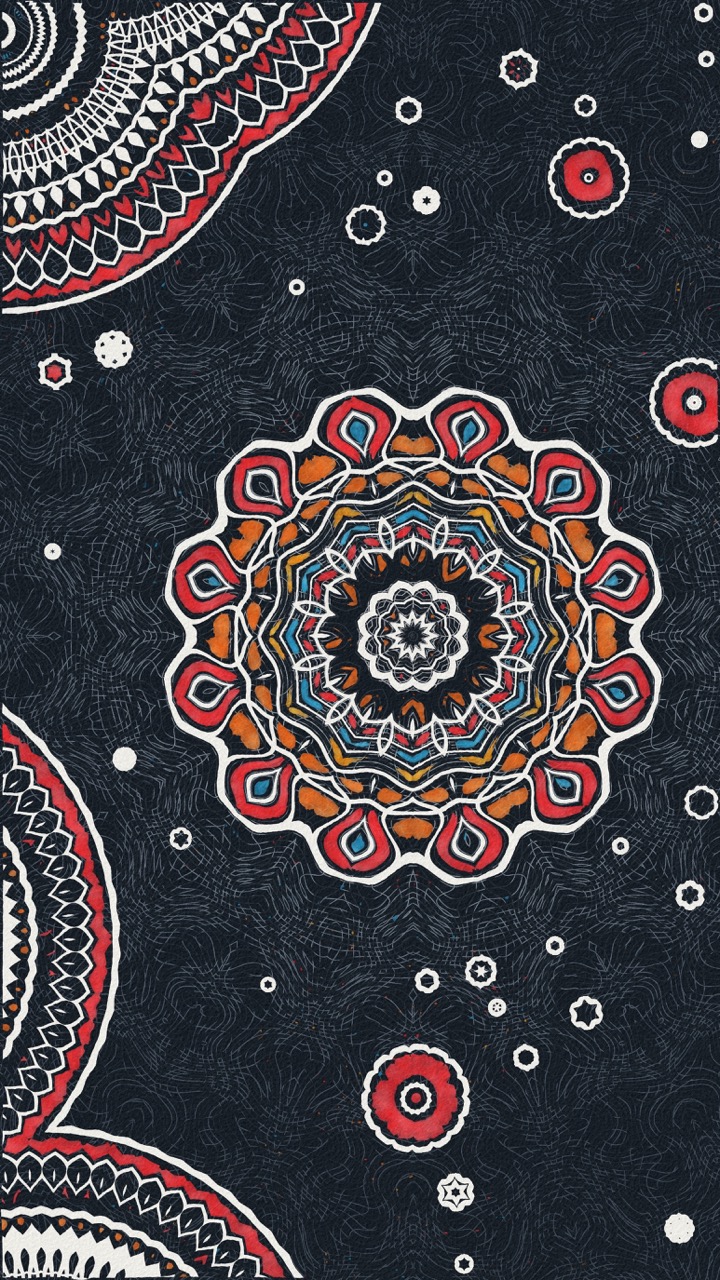
Camille Roux is a French algorithmic artist and software engineer based in Montpellier. Camille writes code that grows organic patterns, such as murmurations or flowing water, out of mathematics and physics. Each work is a system rather than an image, a few simple rules whose outcome no one, not even the artist, can predict. Since 2021, Camille has released 23 long-form generative art series, amounting to more than 9,500 unique works collected, on fx(hash), gm.studio, Bright Moments, 256ART, gm.scribe and EditArt. The work has been shown in New York, London, Berlin, Tokyo and Mexico City, in Venice during the 2024 Biennale, and in 2026 at the Processing Community Days in Tehran and İzmir. We spoke with Camille about drawing with code, chance, and the beauty of simple rules.
How does your background as a computer scientist inform your artistic process?
To me, code has always been an art in itself, a creative practice, so in a way the art was already there.
I started coding as a teenager, and I've now been writing software professionally for more than fifteen years; I still run a tech training company. It's no accident that I ended up building for the web. There was always something concrete at the end, something you could see and use. Code was never just logic. It was a way of making things.
I've always been drawn to artistic creation, mostly through music, which I've played since I was a child. The visual arts, though, had never really attracted me. In 2021 I decided to learn to draw. I pictured myself sketching on a café terrace, but I soon found myself back at my computer, coding what my hand couldn't do. That's how I discovered algorithmic art, and I fell for it straight away. It raised so many questions: how is this made? Why does it move me? Could I do it too? I had to try, and from then on it took up all my free time.
Generative art turned out to be the peak of something I'd always felt: code is a creative medium. It just took me a while to point it at a canvas.
How are you using code as a way of drawing? And how is this reflected in the final result?
I've been writing code since I was a teenager. It's the language I think in, the one I use to describe an idea precisely, so it feels natural that it became my medium, the way a pencil is for someone else.
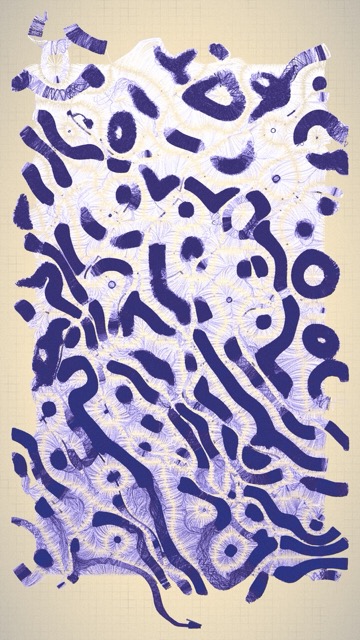
What fascinates me most is emergence: a few simple rules at the heart of an algorithm that can produce wildly different results. ARTERIA (2022), whose name means "artery" in old Occitan, is a good example. It is made of autonomous agents that follow a handful of rules: they move straight ahead, they reproduce, and they die when they cross another agent's path, leaving small circles behind them. I never draw a single line myself. I've never really put words on what appears, either. It's abstract, and what I love is simply watching a few rules give birth to complex patterns, different every time.
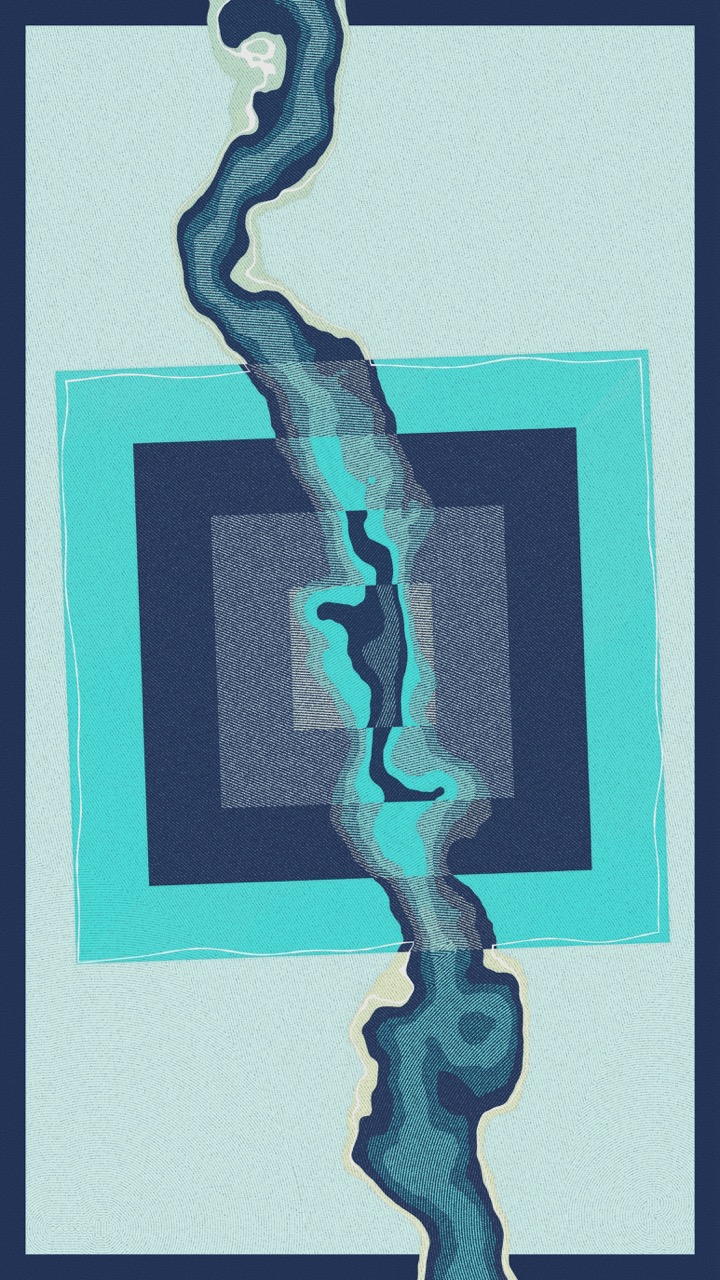
The other game I love is coaxing something organic out of a medium that is completely foreign to it. Left alone, code produces things that are digital, raw and straight. In The Source and The Destination, two series made with Matthieu Segret, we set out to imitate watercolour, pencil lines and brush marks. Nothing could be too straight or too perfect, yet the imperfection had to feel real. That meant a long process of adding noise and randomness, distorting, and comparing with real paintings to see how close we were getting. Résilience plays the same game in its own way.
What interests you about generative art?
Three things: the people, chance, and surprise.
I know software well, so I thought I knew what was technically possible. Generative art still amazed me. We all have the same tools, and yet artists keep inventing things I'd never have imagined. Watching this movement create, again and again, is still one of my greatest pleasures.
Then there's chance. In generative art, randomness is a brush, just as much as the code. I set up the conditions and let chance play within them, so no one knows the result in advance: not the collector, not the platform, not even me. Some outputs still show me things I would never have thought of drawing.
And the community. It's mostly developers, and there's an incredible kindness to it. On most of my recent trips abroad, I've met people I first knew through their work or through a conversation online. Generative art has been a human adventure as much as an artistic one, and that's the part I treasure most.
Finally, the work stays alive. It's a program, not a video file, so it can run in real time on any screen and respond to the world: the weather redrawing a field of isolines, or footfall in a lobby setting a murmuration in motion.
What themes do you explore in your work?
Organic systems: how, in nature, a few simple rules create complex beauty.
A murmuration of starlings is my favourite example. Each bird only follows its neighbours, and yet the whole flock draws shapes in the sky that look designed. I explored this in MURMURATIONS (2021), and the same idea runs through everything I make: flowing water in The Source (2023), contour lines, orbits.
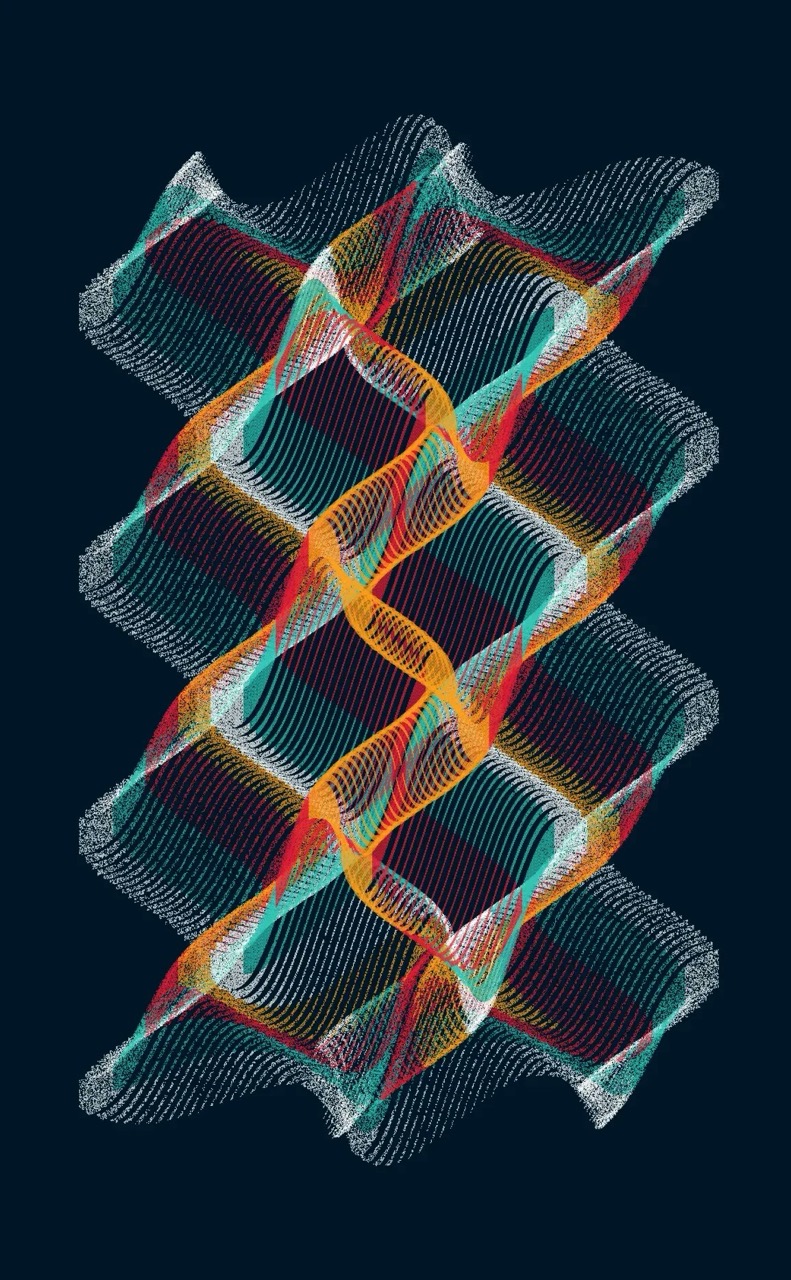
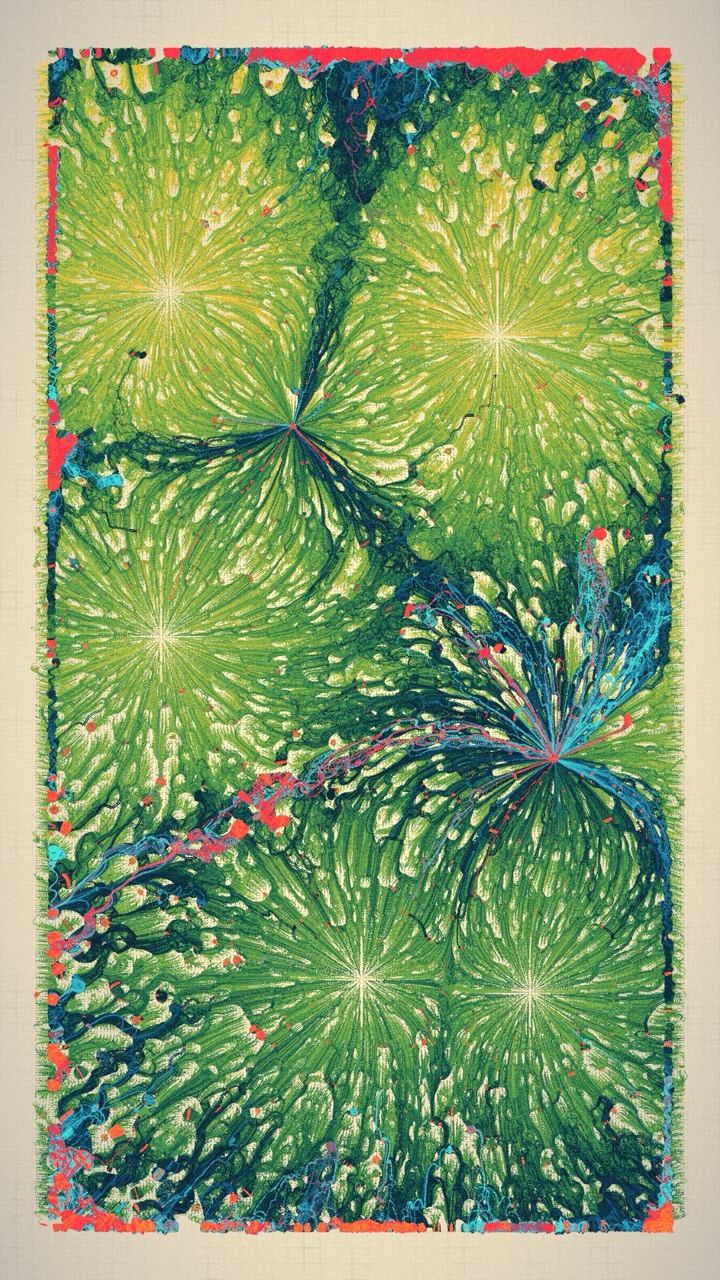
Some series are also deeply personal. Résilience (2024), my first project on Bitcoin, grew out of a health experience that weighed heavily on my life: hyperacusis and tinnitus. But the series isn't a picture of that. Each edition stands for a moment in a life, a trial overcome, a slow transformation, and I left it open on purpose, as I explain below.
How do you want the viewer to feel when looking at your work?
My work is abstract, so I'm happy for people to simply look at it and enjoy it as it is, without any context and without knowing how it was made.
That said, I think a work becomes even richer once you know why and how it was made. When you realise that every piece is made with code, and that each one is driven by something the artist doesn't control, randomness or data depending on the piece, you start to see how tight and complex the constraints are. To me, that adds a whole layer of charm, and it's true of generative art in general.
Résilience is a good example. Underneath it lies what I went through with tinnitus and hyperacusis, but I deliberately made it universal, so that anyone can see in it a difficulty of their own, one they have faced or are about to face, without needing to name it. Knowing that gives the work another dimension, even though it can be enjoyed without it.
Above all, my work may be made with code, but it isn't meant for people who code. I want it to speak to anyone. That's really my goal, and I hope I'm getting there.